
By Jente Vandijck
If you are job hunting in Europe, you already know the ritual: read the listing, scan for the salary, find nothing, apply anyway, and hope the number at the end of four interview rounds does not waste everyone’s time. Our data shows exactly how bad it is - and how different it could be.
We analyzed 1,776,876 job listings posted between April 1 and June 30, 2026, collected directly from the career sites of 48,758 employers running 46+ applicant tracking systems (Workday, Greenhouse, SmartRecruiters and others). This is first-party data: what employers themselves publish on their own hiring pages, not scraped job boards. The headline: only 6.6% of career-site job listings in the EU disclose a salary. In the United States, it is 37.5% - American employers are more than five times more transparent than European ones.
And here is the uncomfortable timing: the EU Pay Transparency Directive - the law that, among other things, gives applicants the right to salary information before the interview - had its implementation deadline on June 7, 2026. One month later, European employers’ job ads are still overwhelmingly silent.
Salary transparency by country: the numbers
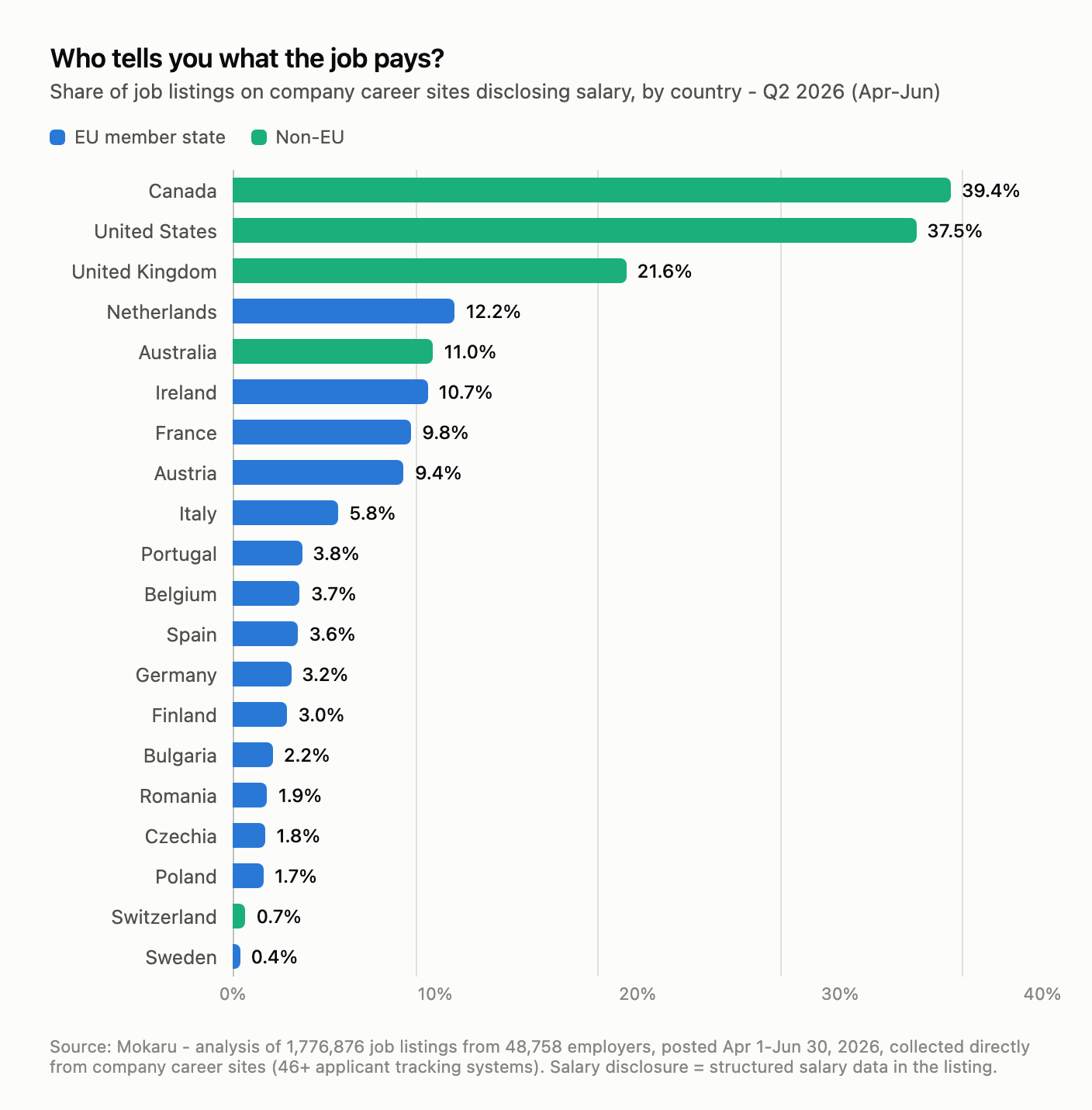
North America sets the pace: Canada (39.4%) and the United States (37.5%) disclose salaries in more than a third of listings, driven largely by state and provincial pay transparency laws. The United Kingdom follows at 21.6%. Inside the EU, the Netherlands (12.2%), Ireland (10.7%), France (9.8%) and Austria (9.4%) lead - and then it falls away fast.
| Country | Career-site listings analyzed | Disclosing salary |
|---|---|---|
| Canada | 56,226 | 39.4% |
| United States | 1,070,977 | 37.5% |
| United Kingdom | 71,803 | 21.6% |
| Netherlands | 23,091 | 12.2% |
| Australia | 21,390 | 11.0% |
| Ireland | 6,280 | 10.7% |
| France | 90,996 | 9.8% |
| Austria | 4,054 | 9.4% |
| Italy | 10,644 | 5.8% |
| Portugal | 5,274 | 3.8% |
| Belgium | 6,013 | 3.7% |
| Spain | 16,274 | 3.6% |
| Germany | 43,349 | 3.2% |
| Finland | 2,033 | 3.0% |
| Bulgaria | 2,290 | 2.2% |
| Romania | 3,510 | 1.9% |
| Czechia | 2,754 | 1.8% |
| Poland | 16,712 | 1.7% |
| Hungary | 2,908 | 1.6% |
| Greece | 5,660 | 1.6% |
| Denmark | 3,053 | 1.4% |
| Norway | 2,496 | 1.1% |
| India | 51,151 | 1.0% |
| Switzerland | 4,936 | 0.7% |
| Sweden | 9,427 | 0.4% |
Some numbers deserve a second look. Germany, Europe’s largest economy, sits at 3.2% - and it is not a data quirk: on Workday, the same platform where American employers disclose salaries in 43.2% of listings, German employers do so in just 2.8%. Same software, same salary fields, radically different behavior. And Sweden - the country that has paused implementation of the directive entirely and wants it renegotiated - is the least transparent job market we measured: 0.4%, fewer than 1 in 200 listings.
The law is here - the salaries are not
The EU Pay Transparency Directive (2023/970) requires employers to tell applicants the initial salary or salary range for a position before the interview - in the vacancy notice or ahead of the interview - and bans asking candidates about their pay history. Member states had until June 7, 2026 to write it into national law.
That deadline was not postponed. The European Commission confirmed in December 2025 that it would stand - no pause, no extension. What happened instead is that most member states simply missed it. Italy, Slovakia, Lithuania and Malta transposed on time. The Netherlands, Denmark and Czechia have pushed implementation to January 2027. Sweden paused entirely.
Has transposing the law translated into transparent job ads? Not yet. Career-site listings in the four on-time countries disclose salaries at 7.8% - statistically indistinguishable from the 7.7% in the countries that delayed or paused. Whatever compliance work is happening inside companies, it is not yet visible in the place candidates look first.
After the deadline: nothing changed
The sharpest test is to look only at listings posted after June 7, 2026 - the ones published when the directive’s deadline had already passed. Of the 129,125 EU career-site listings posted after the deadline, 5.9% disclose a salary - no better than the 7.3% among listings posted before it. US listings are stable across the same split (37.0% vs. 38.0%). If European employers changed anything on the day the law kicked in, it does not show in their job ads.
| Region | Posted Apr 1 - Jun 6 | Posted after Jun 7 |
|---|---|---|
| EU27 | 7.3% | 5.9% |
| United States | 38.0% | 37.0% |
To be fair to the directive: it is early days. Four weeks is not enough time to rewrite hiring workflows, and in most member states the national law that actually binds employers is not yet in force - the bulk of implementations will land between now and January 2027, with enforcement and sanctions following later. The honest conclusion from this data is not that the directive has failed; it is that, one month in, employer behavior has not yet started to move.
We will keep tracking this. Mokaru monitors millions of live job listings every day, so we can measure the directive’s real-world effect as national laws come into force. We will re-run this analysis quarterly and publish the trend - if European job ads start disclosing salaries, this is where you will see it first.
Remote vs. on-site: Europe’s transparency gap
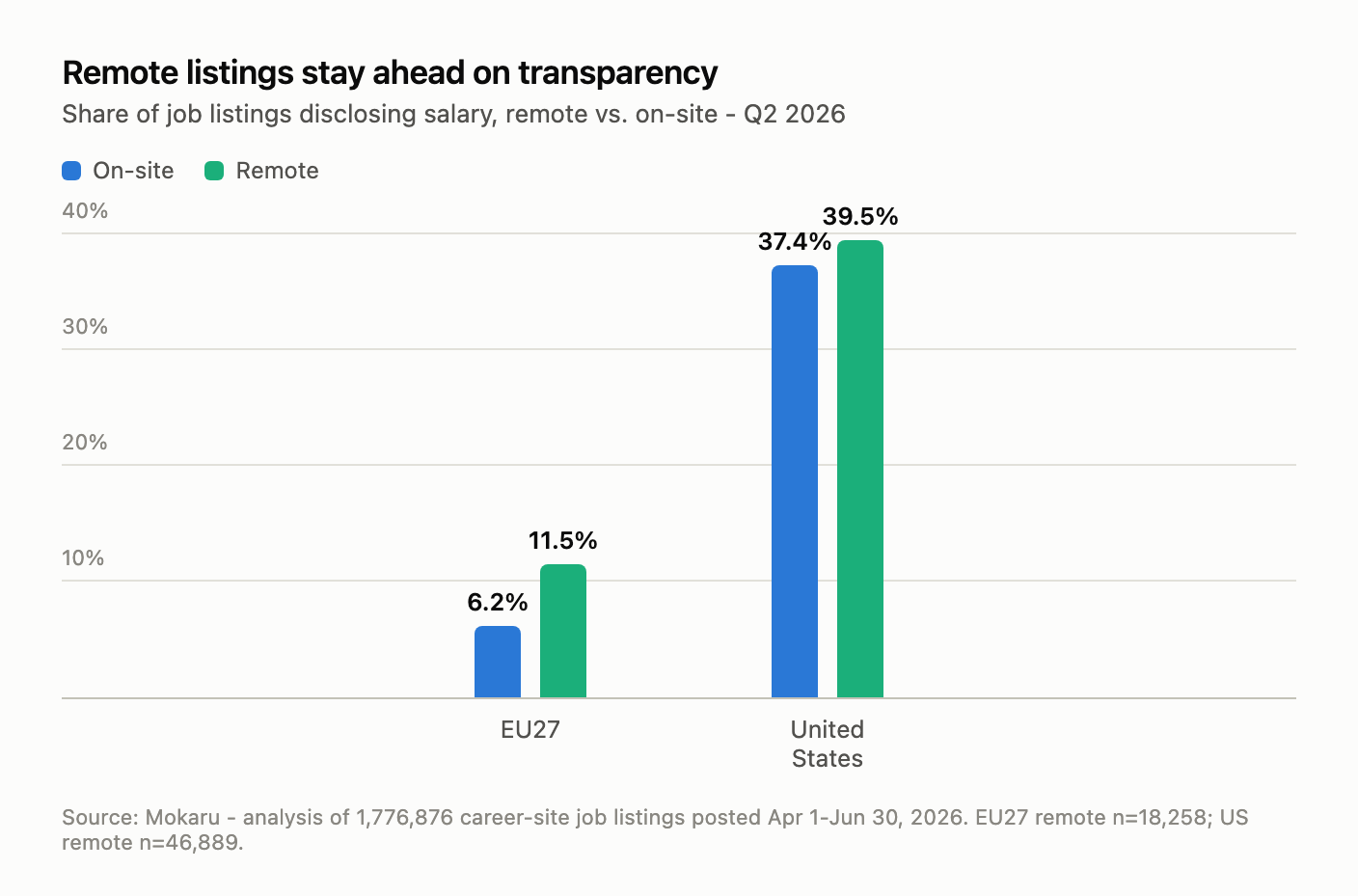
One pattern stands out: remote job listings in the EU are almost twice as likely to disclose salary as on-site listings (11.5% vs. 6.2%). Employers hiring remotely compete in an international talent pool - one where US-style transparency is increasingly the norm. Competition is currently doing more for European pay transparency than regulation.
In the US, the remote/on-site gap barely exists (39.5% vs. 37.4%) - transparency laws there apply regardless of where the work happens.
Who benefits from the silence?
In the US, entry-level listings are the most transparent of all seniority levels (41.8% disclose salary). In the EU, they are the least transparent (3.1%). Whichever way you cut it, the burden of the European information gap falls on the people with the least negotiating leverage: candidates who cannot afford to walk away from four rounds of interviews when the offer finally lands below their floor.
What this means for job seekers
Until the directive has teeth, European candidates are still negotiating in the dark. Three practical takeaways from the data:
1. Remote-friendly listings are your best source of salary information in Europe. If pay clarity matters to you, the 11.5% disclosure rate in remote listings beats anything national job markets currently offer.
2. Know your rights - they may be newer than you think. If you are interviewing in Italy, Slovakia, Lithuania or Malta, the directive’s rules are already national law: you are entitled to salary information before the interview, and employers may not ask what you currently earn.
3. The information asymmetry is the employer’s advantage - close it before you negotiate. Research market rates for your role before the first call, because the listing will not tell you.
Mokaru’s job search covers millions of listings worldwide - including salary data wherever employers disclose it.
Search jobs on MokaruMethodology
This analysis covers all 1,776,876 job listings posted between April 1 and June 30, 2026 that were live in Mokaru’s job index in early July 2026 and were collected directly from company career sites. The listings come from 48,758 distinct employers; Mokaru continuously monitors the hiring pages of over 260,000 companies across 46+ applicant tracking systems (Workday, SmartRecruiters, Greenhouse, iCIMS, SuccessFactors and others). Listings are read from the employer’s own published data, not aggregated from third-party job boards. Listings from aggregator and public job-board feeds - including the EU’s EURES network - are deliberately excluded: those feeds do not reliably carry structured salary data, and including them would unfairly understate European disclosure rates.
“Salary disclosure” means the listing contains structured, machine-readable salary data (a minimum salary or salary range). Salaries mentioned only in free-text descriptions are not counted, so true disclosure rates may be somewhat higher across all countries; this affects every country equally and does not change the relative picture. Country values were normalized (ISO codes and local spellings map to one country); listings whose country field held an ambiguous or non-country value - for example a bare US state code - were excluded from country-level figures. Listings labeled “CA” were counted as Canada only when a Canadian province was present. Country-level percentages are exact counts, not estimates; only countries with at least 2,000 listings are reported.
This data is free to use with attribution. For questions about the dataset, country-level breakdowns we did not publish, or media inquiries, contact us at hello@mokaru.ai.
Frequently Asked Questions

Jente Vandijck
Founder of Mokaru
Jente is the founder of Mokaru, an AI-powered resume builder and job search platform. He works daily with one of the largest independent job listing datasets in Europe and writes about the job market, hiring, and career strategy.
Read More